From Doodles to Masterpieces: Structured Art Classes for Kids
August 25, 2026
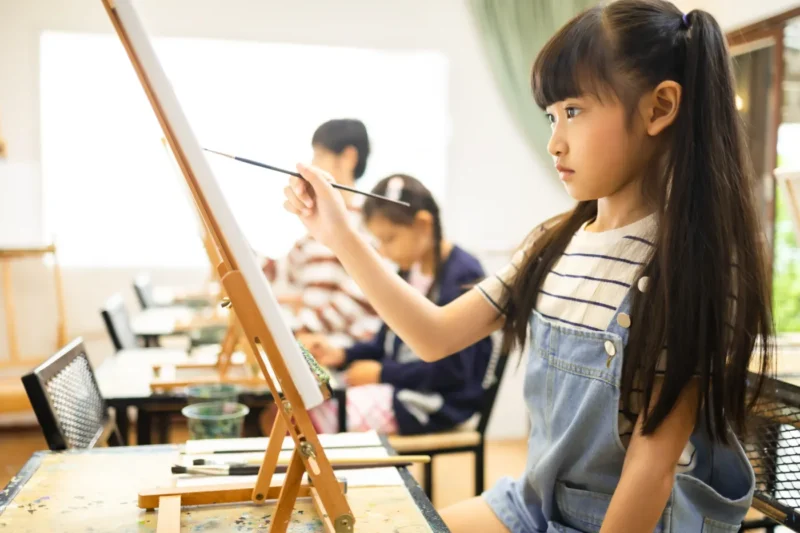
A child focused on her painting in a structured art class, illustrating the hands-on experience offered in art classes for kids.
Summary:
- Structured art classes for kids teach foundational skills step by step: from pencil control and line work through to shading, perspective, and colour mixing.
- Art lessons build transferable abilities beyond the canvas, including patience, focus, observation, fine motor skills, and creative problem-solving.
- A good class balances guided instruction with room for individual expression, with projects matched to each child’s level and constructive, specific teacher feedback.
- Programmes that progress from Elementary through Intermediate to Advanced levels, with placement based on assessment rather than age, give children a clear, structured path as their skills develop.
- Parents in Singapore should look beyond facilities and look for consistent progress, encouraging feedback, and a teacher who explains the process rather than just the result.
Every child draws. Give a 3 year old a crayon and they will fill a page without a moment’s hesitation. But at some point, free scribbling starts to feel limiting; children begin wanting their pictures to actually look like the things they imagine.
That gap between what they see in their heads and what their hands can produce is precisely where structured drawing classes for kids make a difference. According to research on early childhood development, guided art practice not only strengthens creative thinking but also builds skills children draw on in the classroom every day.
What Structured Art Classes for Kids Teach
A well-designed programme covers far more than how to hold a pencil. Over time, children learn that art is not purely about natural talent. It is about practice, patience, and learning to notice what is right in front of them.
Building Foundations Through Guided Practice
Guided practice, sometimes called scaffolding, helps children develop core art habits at a steady, sustainable pace. A teacher might show a class how to sketch a simple bowl before introducing shadows, surface patterns, or background detail.
This kind of structured guidance gives children a safe starting point rather than a blank page and no direction. A 5-year-old child may learn to press lightly with a pencil before committing a line to the page. An older child may begin to understand why objects closer to the viewer appear larger than those further away.
Children in structured art classes also learn to recover from mistakes, a skill that carries well beyond the studio. A smudged line can become a deliberate shadow. An uneven patch of paint can suggest texture on a tree trunk.
Step-by-Step Skills in Shapes, Lines, and Colour
Beginners typically start with the visual building blocks:
Skill AreaWhat Children Learn
| Skill Area | What Children Learn |
|---|---|
| Lines | Straight, curved, wavy, thick, thin, plus how to control each intentionally |
| Shapes | Combining basic forms into recognisable subjects, including the difference between geometric and organic shapes |
| Colour | Basic colours, simple colour mixing, and an introduction to warm and cool colours |
| Composition | How to arrange elements so a picture feels balanced and intentional |
| Tonal Value | How to apply light and dark effects using simple shading and tonal contrast |
These may sound simple, but they are the foundation of all visual art. A child who learns to control a line or mix 2 colours with purpose gains a skill that transfers directly into drawing, painting, collage, and beyond.
How Do Drawing Classes for Kids Support Child Development?
Drawing classes for kids offer something beyond artistic ability. They give children a consistent space to practise focus, patience, and careful decision-making.
Better Focus, Patience, and Creative Confidence
Art involves small, manageable tasks that build concentration naturally. A child might work on filling a sky evenly, adding fine dots to a butterfly’s wing, or waiting for a wash of watercolour to dry before adding the next layer.
Patience develops because art rarely delivers instant results. Children learn to pause, look again, and resist the urge to rush. Creative confidence follows when they begin to see the direct connection between effort and improvement, including children who once insisted they “cannot draw”.
Stronger Observation and Problem-Solving Skills
Observational drawing teaches children to look closely rather than rely on assumptions. A leaf is no longer simply green: it has veins, a central stem, small tears along the edge, and shifting tones near the tip.
Problem-solving follows naturally. If a vase looks flat, a curved line at the base might help. If a fish disappears into the water, a bolder outline or contrasting background colour could be the solution.
Good teachers guide this thinking with precise questions rather than vague encouragement. “Where is the light coming from?” is far more useful than “Make it look nicer”. It teaches children to reason through visual problems rather than guess.
Improved Fine Motor Skills and Hand-Eye Coordination
Art develops the hand and wrist control that supports these everyday classroom tasks:
- Handwriting: Forming letters with consistent pressure and direction.
- Cutting: Following a line cleanly with scissors.
- Colouring: Staying within boundaries and applying even coverage.
- Handling Materials: Working with care and control during classroom activities.
Hand-eye coordination grows every time a child looks at a reference, moves the pencil, checks the result, and adjusts accordingly. These loops of attention and correction directly support learning across subjects.
Thinking about art classes for kids in Singapore? Learn more about Crestar’s drawing classes for kids and how we can support your child’s creative development.
What Happens in Art Classes for Kids
A good art class offers enough structure for children to feel guided, whilst leaving enough room for individual choices and creative expression.
Projects Matched to Each Child’s Level
Teaching should match where a child actually is, not where a programme assumes they ought to be. Placement is based on assessment rather than age, ensuring each child works within a programme suited to their current abilities and readiness.
Encouraging Feedback and Steady Skill Progress
Feedback that builds confidence is specific rather than simply positive. Rather than “well done”, a strong teacher might say: “Your brush strokes are much more even today” or “You noticed the darker tone near the leaf stem, and that detail makes a real difference.”
Revisiting core skills across a range of projects reinforces progress. A child might practise curved lines through a rainbow, a fish, a ceramic bowl, and a portrait. Each task strengthens the same underlying ability with a fresh context.
How to Choose the Right Art Class in Singapore
The right class should suit your child’s age, temperament, and current level. The environment should feel calm, encouraging, and genuinely curious, not simply busy or fast-paced.
Before enrolling, consider the following:
- Review sample student work: do children show individual choices, or does every piece look identical?
- Ask how teachers support children who are shy, restless, or easily frustrated
- Check whether the teacher explains the process, not only the final product
- Confirm the class size allows for enough individual attention
- Ask whether the programme becomes progressively more challenging as skills develop.
A trial class is often the most reliable indicator. Pay attention to how your child responds afterwards, whether they felt comfortable with the teacher, enjoyed the session, and seemed genuinely keen to return.
Help Your Child Grow Creatively with Crestar’s Art Programmes
Looking for drawing classes for kids in Singapore?
At Crestar Learning Centre, our art programme gives children a structured, encouraging space to develop drawing, colouring, observation, and creative thinking skills at a steady pace. With experienced teachers, thoughtfully designed projects, and a genuine focus on each child’s progress, Crestar supports young learners as they take part in art competitions, giving them a meaningful way to build both ability and confidence.
Contact us today to find out more about our programmes and how we can support your child’s creative growth.